Completing a course does not always show that someone can perform the task at work. A practical check, reviewed by a supervisor, can help a training owner decide where more practice or support is needed. The workflow shown below is a proposed concept, not an existing White Storm product.
HOW WHITE STORM WOULD APPROACH IT
A design you can explore.
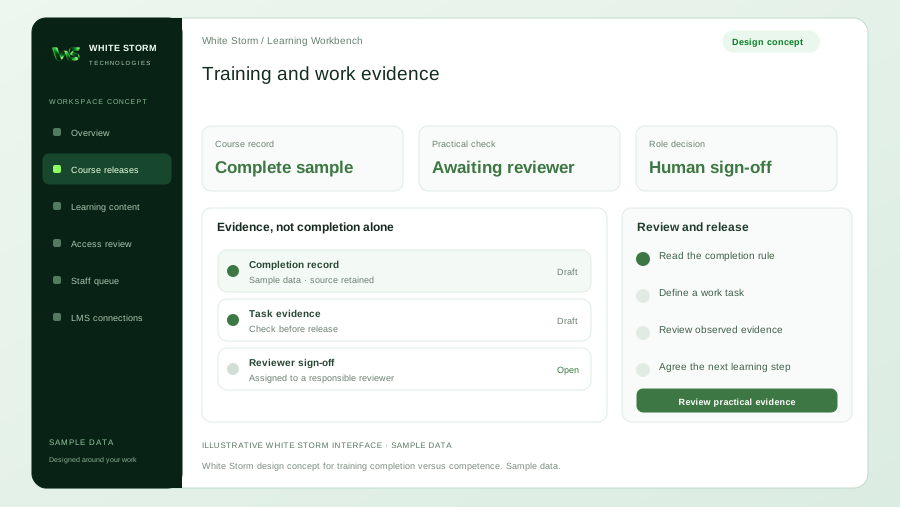
Proposed concept: a training owner compares course completion with a separately reviewed practical task.
Interactive design concept with sample data. This illustrates a possible project; it is not a delivered client system or an available AI product.
 WHITE STORMLearning Workbench
Training and work evidence
Illustrative customer-service training review; completion and task observations are sample records.
Read the completion rule
Task: explain the escalation route
Inputs, tool access, exception handling and acceptance criteria would be agreed with your team before implementation.
Estimate time and cost for your workflow
These editable figures are an illustrative scenario, not a White Storm quote or a forecast. Assisted work, review and expected rework are counted separately.
Enter all costs in the selected currency. Changing the label does not convert amounts.
At the illustrative defaults: 25 hours of monthly capacity, INR10,000 of capacity value after running costs, and an eight-month indicative recovery period.
Time capacity is not guaranteed cash savings. Real benefit depends on workload, quality, redeployment, integrations, licences, hosting, model use and maintenance. A negative result can favour a simpler configured solution.
Hours = monthly cases × (current − assisted − review − rework minutes) ÷ 60. Value after running costs = hours × loaded hourly cost − monthly running costs. Recovery = one-off costs ÷ positive monthly value.
Make the operational question more precise than trained or untrained
A learning manager reports that a team completed a new customer-service course. Operations then asks whether staff can recognise an exception, explain the next step accurately, and route the case to the right person. Those are sensible questions, but they require different evidence from opening a page or finishing a quiz. The course record should retain its meaning instead of being stretched into a broader assurance about workplace performance.
Define the decision the evidence will support. It might be whether to offer supervised practice, update an unclear procedure, or ask a manager to observe a task. A custom workflow should not quietly become a mechanism for employment decisions or professional certification. The institution or employer needs to determine the purpose, authority, and review process before any system starts generating labels about a person's ability.
Inspect what the completion rule actually records
Moodle documents course completion as a report based on configured criteria, and Canvas documents module requirements such as viewing, submitting, or achieving a score. These features can be entirely appropriate for their intended purpose. The design inference is to preserve the configured rule alongside a completion record, then collect separate evidence when the business question concerns a practical task that the rule does not assess.
In an illustrative service team, the course asks staff to identify the correct escalation policy in a short quiz. The work task asks them to explain that route to a customer whose case contains an exception. A proposed evidence view keeps the quiz completion and the observed explanation in separate columns. It lets a supervisor record what was demonstrated and what needs another practice opportunity without rewriting the original course result.
Design a small practical check with a named reviewer
Start with a task analysis from the person responsible for the work. Name the observable steps, the conditions of the check, the evidence to retain, and the criteria a reviewer will use. A simulated case may be sufficient for a low-consequence practice decision; some roles require other forms of assessment determined by the organisation. Do not let an AI-generated scenario choose the standard of acceptable performance by default.
Useful inputs include course identifiers, completion definitions, procedure versions, example cases, the approved review rubric, and supervisor permissions. A proposed AI step could prepare draft scenarios or organise reviewer notes into the agreed criteria. A qualified reviewer checks the scenario and the recorded interpretation. Any generated summary should link to the permitted evidence and distinguish observed behaviour from the model's suggested explanation.
Keep two evidence records and a transparent follow-up decision
White Storm could bring read-only LMS completion records into a separate practical-assessment review queue once the requirements are agreed. The queue would show whether a practical check is requested, scheduled, observed, or awaiting review. A missing observation must remain missing. It should not be displayed as a failed skill or silently filled from course activity. Staff should be able to correct a mapping error without changing the historical learning record.
A reviewer can recommend an additional example, supervised practice, a procedure clarification, or another observation. Record the reason and the owner of that next step. If a procedure changes, identify which checks used the earlier version. Reviewers may decide that some evidence remains relevant while another check needs repeating. That decision should be visible rather than hidden in a newly calculated overall readiness score.
Tell participants what the practical check is for and who can see its evidence. Keep retention proportionate to the agreed purpose and provide the organisation's route for questioning an inaccurate record. A convenient dashboard can otherwise spread tentative observations farther than intended. The initial pilot can avoid broad individual rankings and concentrate on whether the training process produces the evidence the team actually needs.
Agree when an observation needs refreshing. A changed procedure, a new work environment, or a long interval may prompt another check, depending on the organisation's policy. Keep that decision separate from an expired course record. The workflow should show which evidence remains current for its stated purpose and who made that judgment.
Acceptance should expose false reassurance and false failure
Test a completed course with no practical observation, an observation against an old procedure, a course completed under a different rule, a review awaiting a second opinion, and a learner with an approved alternative assessment route. Require the display to describe each state accurately. A supervisor should be able to trace a recommendation to the task, rubric, reviewer, and evidence version without relying on an AI confidence label.
Pilot measures can include review consistency, time to collect usable evidence, unresolved review cases, and whether follow-up tasks are completed. Any claim that work performance improved needs a separate evaluation with appropriate observations and context. Do not infer business impact from a rise in completed training or generated practice questions. Sometimes the useful finding is that the existing course already assesses the required task adequately.
Budget for observations and calibration
Estimate review hours = participants × observed tasks × reviewer minutes per task / 60 + reviewer calibration + disputed-case review. For thirty sample participants completing two eight-minute observations, direct review is eight hours before calibration. These are hypothetical inputs for planning, not a vendor price or a promised efficiency. They help a buyer see why cheaper text generation does not remove the cost of credible practical evidence.
Implementation cost depends on task definitions, evidence formats, LMS mappings, reviewer permissions, and follow-up integration. Running cost includes storage, supervisor time, model use where justified, procedure updates, and reporting maintenance. A standard LMS assignment and an existing supervisor checklist may already provide enough. Commission custom work when the gap is demonstrable across repeated training cycles and the organisation can sustain the review process that gives the evidence meaning.
Sources & further reading
Research reviewed on 17 October 2026. Platform capabilities depend on version, plan and configuration. Primary references checked for this article. Practical examples are illustrative, not client results.
Apply this to your project.
Talk to us about combining course-completion records with practical task evidence and supervisor reviews, so training teams can see where further checks or support are needed.
Explore LMS AI Integration