Copying a course does not confirm that its reading list, links, local instructions, and teaching responsibilities are ready for the next intake. A proposed review workspace could help course owners check those details and approve exceptions before release. The example below illustrates a possible project, not an existing White Storm product.
HOW WHITE STORM WOULD APPROACH IT
A design you can explore.
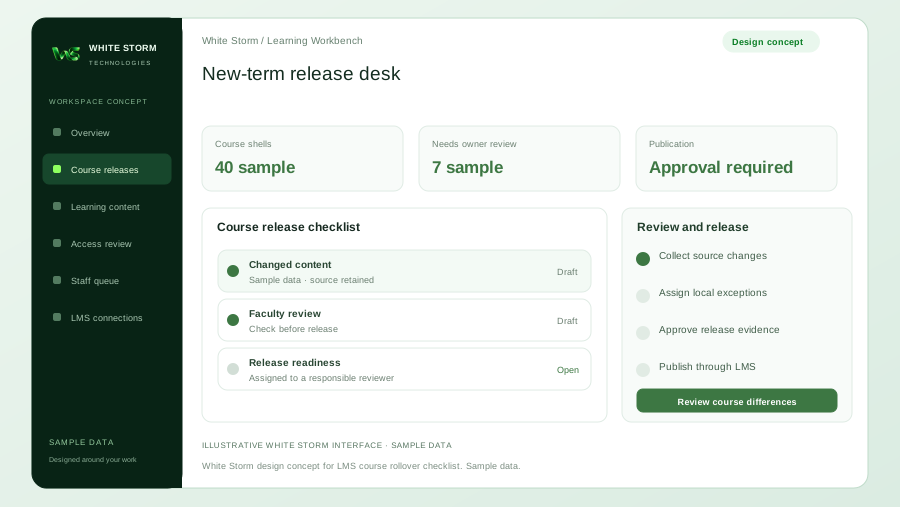
Proposed concept: an owner reviews differences and local exceptions before approving a course release.
Interactive design concept with sample data. This illustrates a possible project; it is not a delivered client system or an available AI product.
 WHITE STORMLearning Workbench
New-term release desk
Illustrative review of copied course shells before a new intake; counts are sample data.
Collect source changes
Local exception: placement handbook
Inputs, tool access, exception handling and acceptance criteria would be agreed with your team before implementation.
Estimate time and cost for your workflow
These editable figures are an illustrative scenario, not a White Storm quote or a forecast. Assisted work, review and expected rework are counted separately.
Enter all costs in the selected currency. Changing the label does not convert amounts.
At the illustrative defaults: 25 hours of monthly capacity, INR10,000 of capacity value after running costs, and an eight-month indicative recovery period.
Time capacity is not guaranteed cash savings. Real benefit depends on workload, quality, redeployment, integrations, licences, hosting, model use and maintenance. A negative result can favour a simpler configured solution.
Hours = monthly cases × (current − assisted − review − rework minutes) ÷ 60. Value after running costs = hours × loaded hourly cost − monthly running costs. Recovery = one-off costs ÷ positive monthly value.
The expensive gap sits between copying and approving
Programme teams often prepare the next term by copying a master course into several delivery shells. The central team changes a handbook, one lecturer keeps a local laboratory instruction, and another replaces a reading with an accessible alternative. A spreadsheet then becomes the only record of which differences are deliberate. The problem is coordination across course instances, rather than a shortage of content-generation features.
Start by mapping the actual release decision: which course instance is being approved, against which master version, by which academic owner, for which intake. Separate successful transfer from instructional readiness. A copied item may be present but inappropriate for a particular delivery. The release desk should make that distinction inspectable without asking an AI model to decide whether an academic change is acceptable.
Keep the existing LMS distribution tools in the design
Canvas documents Blueprint operations for identifying changes since a synchronisation and reviewing migrations. Moodle documents course copying and the permissions involved. These are useful foundations. A custom proposal should first demonstrate why those facilities, a clear template policy, and an ordinary checklist do not already cover the institution's needs. The platform remains responsible for its supported copying and synchronisation behaviour.
Consider an illustrative provider with forty course shells across three campuses. A master safety guide changes, but two campuses need different equipment instructions. The proposed desk groups common changes and highlights those local exceptions. It does not overwrite every difference to make the dashboard green. The two campus owners approve their versions, while the central owner confirms which shared items must stay aligned.
Collect identifiers and dependency evidence before asking for summaries
The useful inputs are course and item identifiers, master-to-copy relationships, modification timestamps, approved release labels, document ownership, link destinations, and the institution's rules for local adaptation. A small inventory should also name files used by more than one item. A changed file can affect several learning activities even when their page text has not changed. Personal student records are unnecessary for this content-only pilot.
Use approved LMS APIs or supported exports to gather the inventory. Keep a checkpoint for each collection run and show incomplete reads explicitly. AI can propose a short description of a textual difference, but the screen should retain the before-and-after content and its source links. A failed connector must leave the course unverified, rather than silently treating missing evidence as an absence of changes.
Give every exception a destination and a release consequence
Use a small set of actionable states: awaiting owner, accepted local variation, correction required, ready for final check, and approved. Store the reason for an accepted difference. An equipment-specific worksheet might be valid for one campus, while an obsolete assessment brief needs replacement everywhere. The release owner needs to see both cases without reading a long conversation history or searching through email acknowledgements.
White Storm could connect these review decisions to the institution's existing course-approval process once the requirements are agreed. Initial publication could remain a manual action in the LMS. If write actions are later requested, specify their permitted targets, approval requirements, retry behaviour, and recovery path separately. Review approval should expire when the relevant source changes; it must not become a permanent badge on a moving course.
Agree a recovery procedure before the first live rollover. The release record should identify the approved prior package, the affected course instances, and the person who can reverse or correct an unintended change. A rollback may need care when learners have already interacted with an activity, so it should follow the LMS process and the academic owner's decision. Keep a release freeze window where appropriate and explain how urgent corrections enter the queue. For the pilot, choose one master course, a few representative copies, and one known local exception. That small slice can demonstrate whether the proposed evidence is useful before the team inventories the whole catalogue or gives a connector permission to edit live content.
Accept the desk only when awkward rollovers are visible
Build the acceptance set from a few real course structures with synthetic or non-personal content where possible. Include a renamed file, a broken internal link, an unchanged title with changed instructions, an approved local exception, and a central update made after local approval. Staff should be able to trace each warning to an item and explain the expected release consequence. Test copied courses with different local naming conventions.
Require the pilot to distinguish an incomplete import from a complete review, and to reopen the relevant decision after a new edit. An owner should be able to export the final evidence register and identify who approved each exception. Measure review time and missed actionable differences against the existing process. A large number of AI-generated summaries is not evidence that the next term's materials are ready.
Estimate coordination work and the continuing review bill
Use a planning equation: rollover review hours = course shells × minutes of common checks per shell / 60 + local exceptions × review minutes per exception / 60 + final owner checks. For an illustrative forty shells at six minutes each, the common-check component is four hours. That is an input to compare with a pilot, not a promised saving. Add the time needed to resolve problems that the check discovers.
Implementation effort depends on the number of course-copy relationships, item types, permission models, and approval routes, plus integration and recovery testing. Running cost includes connector monitoring, storage, model calls if summaries are enabled, and academic review. A native checklist may be the better choice for a small, uniform catalogue. Commission a custom desk only when repeated coordination failures justify maintaining another operational tool.
Sources & further reading
Research reviewed on 17 October 2026. Platform capabilities depend on version, plan and configuration. Primary references checked for this article. Practical examples are illustrative, not client results.
Apply this to your project.
Talk to us about a course-release workspace that brings materials, links, and review decisions together, so course owners can approve what is ready for learners.
Explore LMS AI Integration