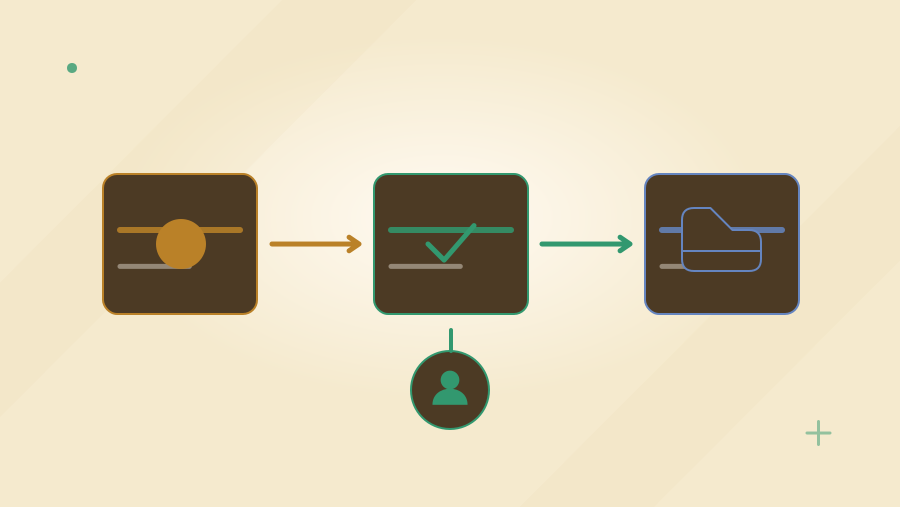
A customer may mention a possible launch date without committing to it. Show the original statement beside each proposed CRM change, and let the account owner approve the changes individually.
HOW WHITE STORM WOULD APPROACH IT
A design you can explore.
Illustrative White Storm project concept with sample records; not a live product or client implementation.
Interactive design concept with sample data. This illustrates a possible project; it is not a delivered client system or an available AI product.
 WHITE STORMCRM Review Desk
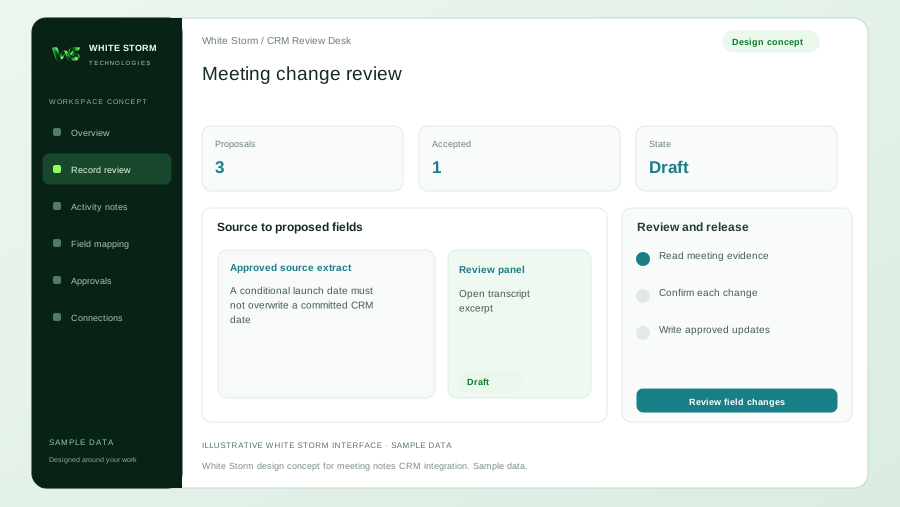
Meeting change review
A conditional launch date must not overwrite a committed CRM date
Read meeting evidence
Open transcript excerpt
Inputs, tool access, exception handling and acceptance criteria would be agreed with your team before implementation.
Estimate time and cost for your workflow
These editable figures are an illustrative scenario, not a White Storm quote or a forecast. Assisted work, review and expected rework are counted separately.
Enter all costs in the selected currency. Changing the label does not convert amounts.
At the illustrative defaults: 25 hours of monthly capacity, INR10,000 of capacity value after running costs, and an eight-month indicative recovery period.
Time capacity is not guaranteed cash savings. Real benefit depends on workload, quality, redeployment, integrations, licences, hosting, model use and maintenance. A negative result can favour a simpler configured solution.
Hours = monthly cases × (current − assisted − review − rework minutes) ÷ 60. Value after running costs = hours × loaded hourly cost − monthly running costs. Recovery = one-off costs ÷ positive monthly value.
A polished summary can still update the wrong field
A sales meeting may mention an aspirational launch date, a provisional budget, and a question about procurement. If those remarks become a committed close date, an approved amount, and a qualified decision maker, the CRM tells a story the customer never agreed to. A narrative summary and a structured record update serve different purposes. The workflow should retain that distinction, even when both outputs originate from the same transcript. Start by identifying which fields affect forecasting, delivery promises, or someone else's next task.
Check existing meeting and CRM assistance first
Microsoft documents sales meeting recaps, CRM notes, and suggested follow-up actions. HubSpot's Breeze can summarise CRM records. These capabilities should be evaluated in the client's licensed environment before building a separate assistant. The remaining problem might be a custom opportunity schema, multiple deals discussed in one call, or an agreed review rule rather than a missing AI feature. A fair proposal identifies the evidence and mapping that the available configuration cannot yet present in the form your sellers need.
Define the client inputs field by field
Provide approved transcript samples, meeting-to-record association rules, the CRM field dictionary, picklist values, ownership rules, and examples of acceptable notes. The sales operations owner should distinguish observations, customer statements, seller interpretations, and authorised commitments. Specify whether recordings or transcripts may be processed, which participants must be informed, and how long sources remain available. Include calls discussing more than one project and notes corrected by the meeting owner. A technically valid value is not necessarily a commercially agreed value, so both kinds of validation need owners.
Review a conditional date without turning it into a promise
In an illustrative call, a buyer says, 'October might work if security review finishes.' The concept screen would propose an October planning window with a condition, not silently overwrite the contractual delivery date. It could draft a task for the account owner to clarify security-review timing, linked to the relevant excerpt. A separate statement confirming the next meeting might support a dated follow-up task. The reviewer could accept the note while rejecting a field change, allowing useful capture without endorsing every inferred action.
Review and save each approved CRM change
White Storm could scope a review panel showing the current CRM value, proposed value, source excerpt, and reason for each change. Keep notes, tasks, and opportunity properties as separate choices. After approval, re-read affected records, check edit permissions, and record which writes succeeded. If a task is created but an opportunity update fails, show partial completion instead of presenting a single success badge. Store the originating meeting identifier so a retried run does not create another set of tasks from the same accepted actions.
Test uncertainty and the reviewer experience
Acceptance cases should include contradictory speakers, negation, tentative figures, changed currencies, absent transcripts, and two opportunities with similar names. Reviewers need a quick path to the source, an editable proposal, and a way to say no update is appropriate. Test whether approved changes still reflect the corrected transcript and whether later edits invalidate a pending proposal. Track field-level correction rates alongside handling time. A summary that sounds persuasive but repeatedly requires a seller to reopen the recording may not offer the expected operational benefit.
Prefer a configured recap when it meets the job
A native recap and a disciplined meeting template may be sufficient when the team only needs notes and a few standard tasks. Consider custom integration when the source evidence, approval granularity, or record associations remain awkward after configuration. The deliverable should include sample mappings and a review guide, not a claim that the system understands commercial intent perfectly. Ask the supplier to show a declined field update and a partial-write recovery during the demonstration; these are central to the workflow, not optional edge cases.
Price the complete operating workflow
Measure notes, field entry, task creation, and seller corrections separately. A summary-only tool and an approved multi-record update have different delivery effort and review costs.
Planning example only, not a quotation or forecast: assume 160 items each month, 12 minutes of current handling per item, 4 minutes of proposed human review per item, and another 10 minutes of rework for 10% of items. The difference is about 18.7 staff hours per month. At an assumed USD 40 per staff hour, that represents about USD 747 of capacity before operating costs. These invented inputs demonstrate the calculation; measure your own volumes, handling times, exception rate, and labour cost before making a purchasing decision. Released capacity is not automatically a payroll saving.
Separate the cost of obtaining an approved transcript from the cost of proposing CRM updates. Include meeting or transcription licences, model usage, record lookups, and seller review of individual fields. Delivery effort includes mapping custom properties, testing conditional statements, and recovering partial writes. Budget maintenance when the meeting platform, transcript format, or opportunity schema changes. Ask how source retention and deletion affect review links. The handover should let sales operations revise mappings and test a corrected transcript without depending on an undocumented prompt or assuming that every meeting has usable evidence.
Sources & further reading
Research reviewed on 17 October 2026. Platform capabilities depend on version, plan and configuration. Primary references checked for this article. Practical examples are illustrative, not client results.
Apply this to your project.
Discuss turning meeting notes into proposed CRM updates, with the original statements beside each suggestion and account-owner approval before changes are saved.
Explore AI Agent Development