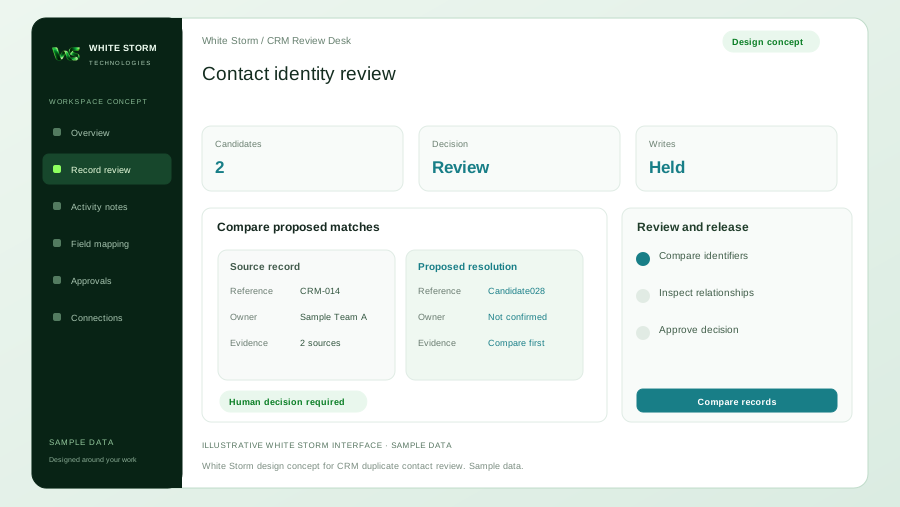
A shared email address can belong to several people, while one person may use several addresses. Check the associated companies, conversations, and open opportunities before deciding whether two CRM records should be merged.
HOW WHITE STORM WOULD APPROACH IT
A design you can explore.
Illustrative White Storm project concept with sample records; not a live product or client implementation.
Interactive design concept with sample data. This illustrates a possible project; it is not a delivered client system or an available AI product.
 WHITE STORMCRM Review Desk
Contact identity review
Shared mailbox with two legitimate relationship histories
Compare identifiers
View relationship evidence
Inputs, tool access, exception handling and acceptance criteria would be agreed with your team before implementation.
Estimate time and cost for your workflow
These editable figures are an illustrative scenario, not a White Storm quote or a forecast. Assisted work, review and expected rework are counted separately.
Enter all costs in the selected currency. Changing the label does not convert amounts.
At the illustrative defaults: 25 hours of monthly capacity, INR10,000 of capacity value after running costs, and an eight-month indicative recovery period.
Time capacity is not guaranteed cash savings. Real benefit depends on workload, quality, redeployment, integrations, licences, hosting, model use and maintenance. A negative result can favour a simpler configured solution.
Hours = monthly cases × (current − assisted − review − rework minutes) ÷ 60. Value after running costs = hours × loaded hourly cost − monthly running costs. Recovery = one-off costs ÷ positive monthly value.
The expensive mistake is the wrong merge
Two customer records can look similar and still represent different people. A shared admissions inbox might belong to an institution, while two employees use it for different projects. One person might also appear under a personal address and a work address. Removing the apparent duplicate without checking relationships can combine private correspondence, distort ownership, and attach an opportunity to the wrong decision maker. The operational target should be correct identity resolution, with a documented decision, rather than the largest possible reduction in record count.
Start with the controls already in the CRM
HubSpot documents email-based contact deduplication; Salesforce supports configurable matching and duplicate rules. Test those controls before commissioning another matching service. Their existence does not settle how your organisation identifies a consultant with several clients or a customer who changes employer. AI can propose similarities in messy names and notes, but an apparent match is evidence for review, not permission to merge. The specific gap worth scoping is ambiguous identity across approved sources and the downstream relationships affected by a proposed decision.
Bring examples of both matches and lookalikes
A client should provide redacted record exports with stable IDs, source-system identifiers, contact ownership, associated companies, current opportunities, and examples of earlier merge mistakes. Include shared addresses, aliases, transliteration, abbreviated organisation names, and legitimate contacts who happen to share a name. A data owner must specify which identifiers are authoritative and who may approve changes. Record whether correspondence may be moved between records and which integrations consume the CRM ID. An integration inventory matters because a seemingly successful merge can leave another application holding a retired identifier.
Work through a realistic candidate pair
In an illustrative training-provider example, two records named Sam Patel share the same institutional mailbox. One is linked to a purchasing discussion and another to course administration. The proposed review screen would show both relationship histories, the matching fields, and the source of each value. A reviewer could choose keep separate, associate with the same organisation, or request more information. If the evidence later establishes one person, the reviewer would select a surviving record and inspect which fields and activities would change before confirming a merge.
Scope a decision assistant rather than a cleanup button
White Storm could design a candidate queue that separates exact approved identifiers from softer similarity signals. The first release could suggest candidates and record reviewer decisions without writing changes. A later authorised step could use supported CRM operations, retaining a decision reference and the affected record IDs. Do not ask a language model to manufacture a missing identity attribute. Keep the original values alongside proposed normalisation, and refresh the record immediately before action so a colleague's recent correction does not disappear beneath an older recommendation.
Make the acceptance set include harmful false matches
Review a labelled set containing genuine duplicates and deliberately similar nonduplicates. Measure wrong merges separately from missed matches; averaging them hides very different consequences. Test shared mailboxes, changed company associations, missing permissions, and a record edited while review is open. An unresolved pair should remain unresolved rather than being forced into a binary decision. A supervisor should be able to inspect why a candidate was generated and identify any downstream repair required after an authorised merge. Verify export and recovery arrangements before allowing destructive changes.
Choose configuration unless ambiguity warrants more
If native duplicate rules, unique identifiers, and a better import process solve the observed errors, configure those tools and train the team. A custom review layer becomes reasonable when the same ambiguous cases recur across systems and reviewers need relationship evidence that is not available in one view. Ask the supplier to demonstrate a difficult nonmatch, not only an obvious duplicate. The engagement should produce a tested matching policy, review workflow, and operational handover rather than an undocumented score that staff must trust.
Price the complete operating workflow
Time the search for supporting relationship evidence as well as the merge itself. Include the cost of correcting a wrong association and the data steward who resolves difficult pairs.
Planning example only, not a quotation or forecast: assume 400 items each month, 6 minutes of current handling per item, 2 minutes of proposed human review per item, and another 8 minutes of rework for 10% of items. The difference is about 21.3 staff hours per month. At an assumed USD 40 per staff hour, that represents about USD 853 of capacity before operating costs. These invented inputs demonstrate the calculation; measure your own volumes, handling times, exception rate, and labour cost before making a purchasing decision. Released capacity is not automatically a payroll saving.
Price native duplicate-rule configuration separately from an additional review interface. Implementation effort includes identifier mapping, labelled examples, permission testing, and a plan for retired record IDs. Operating costs include data-steward review, model comparisons where used, connector licences, and investigation of disputed matches. Allocate maintenance time when an import source changes or the CRM association model evolves. Request an estimate for repairing a mistaken merge as well as processing an easy candidate. The handover should explain which identifiers govern each decision and who can authorise destructive changes.
Sources & further reading
Research reviewed on 17 October 2026. Platform capabilities depend on version, plan and configuration. Primary references checked for this article. Practical examples are illustrative, not client results.
Apply this to your project.
Talk to us about reviewing possible CRM duplicates using account relationships and source records, with staff approval before contacts are merged or their histories are changed.
Explore AI Agent Development