Start from a repeated operational task
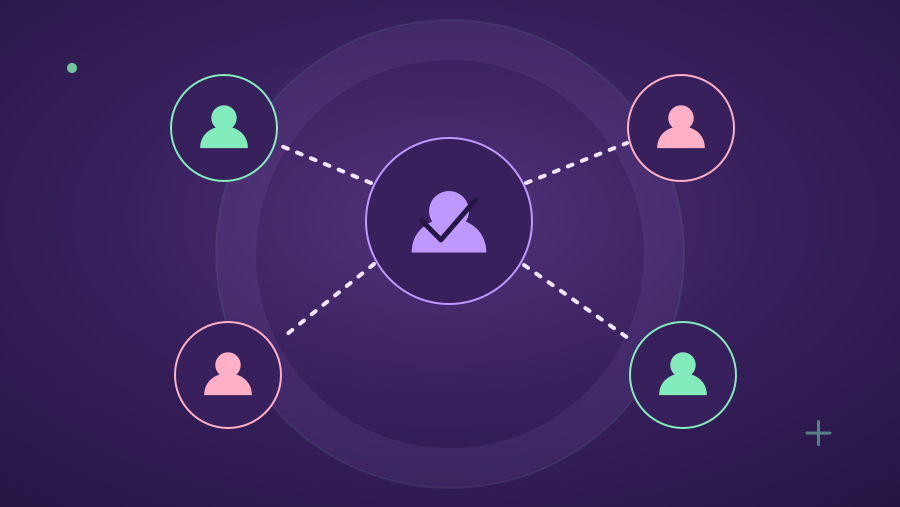
A useful first automation project starts with a specific task and a named owner. Describe its trigger, inputs, decisions, outputs, and exceptions. Examples might include preparing a weekly service summary, extracting fields from approved enquiry messages, or drafting a research brief from selected public sources. The institution should be able to recognise when the task has been completed correctly.
Avoid making the first brief simply build an AI agent. That phrase describes a possible technical approach, not the operational result. Some tasks need fixed rules, some benefit from AI-assisted interpretation, and some require staff judgment throughout. Anthropic distinguishes predefined workflows from agents that dynamically choose steps. Use that distinction to discuss how much flexibility the task actually requires.
Compare candidates against practical criteria
List candidate tasks and assess source readiness, ownership, permission requirements, exception frequency, and recovery options. Prefer a task whose inputs can be inspected and whose output has a clear review standard. A workflow with unavailable data or disputed responsibility may need process improvement before automation can help. Apparent repetition alone does not establish readiness.
An illustrative education provider might compare drafting a weekly support summary with automatically approving fee adjustments. The summary has a reviewable output and can initially remain a draft. Fee adjustments involve individual decisions and financial consequences. The comparison does not mean the second workflow can never be improved; it shows why its first delivery phase would need a different boundary and stronger authorisation controls.
Choose a narrow action boundary
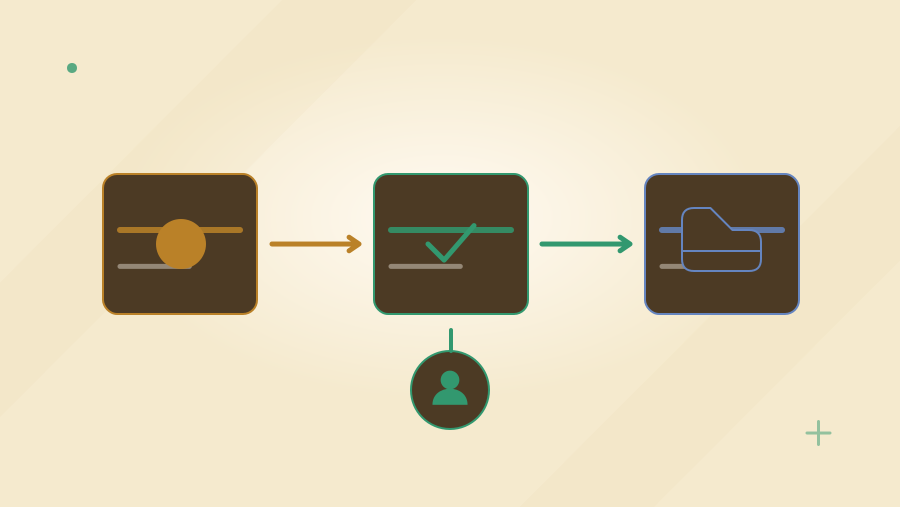
Separate reading information, drafting a result, proposing an action, and executing it. A first pilot can produce a draft for staff without sending messages or changing records. Name each permitted system operation and restrict its resources. If the task only needs a particular queue or folder, broad account access is an unnecessary dependency.
For an illustrative support-summary workflow, the assistant might read a sanitised export, group issues using an approved category set, and draft a report with references to the underlying records. Staff would inspect the draft before publication. This boundary lets the team evaluate classification and summarisation without giving the pilot the ability to contact students or modify their cases.
Map exceptions and recovery
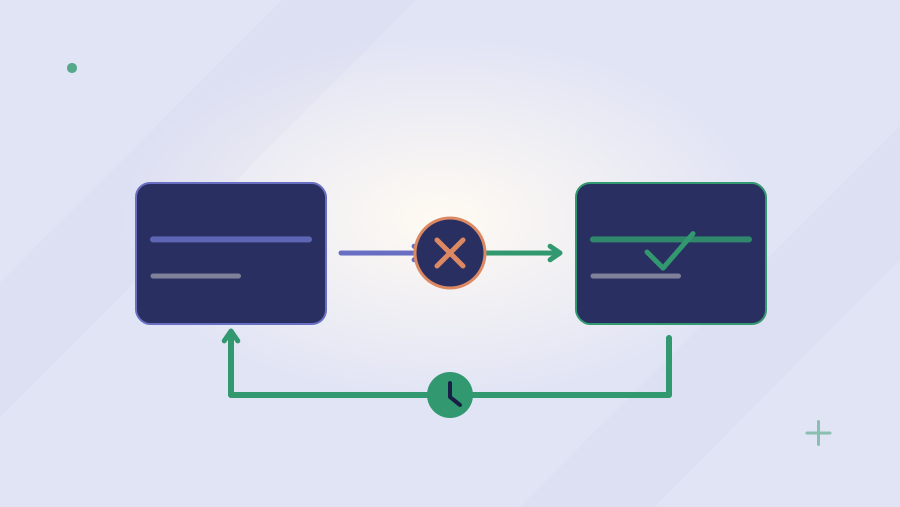
Document what should happen when a required field is missing, a source conflicts with another, a connector times out, or the model cannot produce a valid result. Include a safe stopping point and an owner for unresolved items. A process that works only for ideal inputs will move exception work somewhere else rather than remove it.
Design retries so they cannot accidentally repeat an external action. Keep enough execution evidence to distinguish not attempted, attempted with an unknown outcome, and confirmed complete. The appropriate recovery depends on that state. An operator should be able to identify the affected item and resume or close it without guessing what the assistant already changed.
Evaluate against the current process
Collect a representative set of tasks and establish how staff currently assess quality and effort. Then compare the pilot's outputs, corrections, exceptions, and total handling work. Include review time and downstream rework in the assessment. A faster generated draft may provide little benefit if staff must investigate frequent errors or reconstruct missing references.
Agree acceptance criteria before examining results. Criteria can cover output accuracy, evidence traceability, permission boundaries, failure handling, and staff usability. NIST's AI Risk Management Framework is a useful governance reference, while the pilot must supply local evidence for the chosen task. Keep proposed thresholds clearly separate from observed results and avoid projecting a limited trial into a universal savings claim.
Prepare a delivery brief
White Storm Technologies scopes custom AI agent and business-process projects around the selected workflow. A useful discovery pack includes a process sketch, sanitised input examples, acceptable outputs, exception cases, and the systems involved. Identify the person who can approve process changes and the person who will operate the pilot after handover.
- Select one task with a clear trigger, owner, output, and quality standard.
- Start with limited resources and actions that match the pilot's actual needs.
- Define exception routing, duplicate prevention, recovery, and a way to pause execution.
- Expand only after the team can show useful results and maintain the workflow.
Sources & further reading
Primary references checked for this article. Practical examples are illustrative, not client results.
Apply this to your project.
Discuss where an AI assistant could help your team handle recurring work, with agreed permissions, human approval for important actions, and a clear route for exceptions.
Explore AI Agents & Business Automation