Make the architecture answer a task question
A single assistant can interpret a request, retrieve approved information, and produce an answer. A controlled workflow can connect several defined steps. A system with multiple agents can distribute work among separate roles or contexts. The right choice depends on the task, available evidence, permission boundary, and quality standard. More agents do not by themselves establish better results.
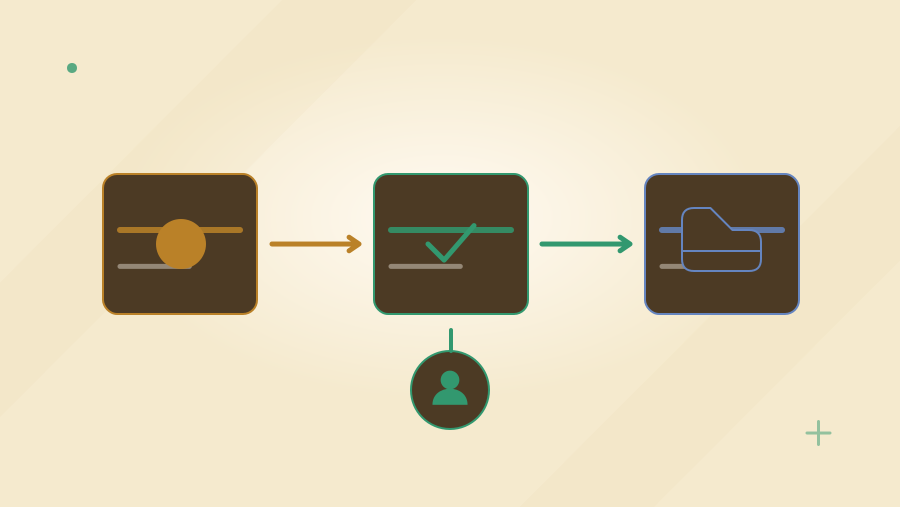
Begin with a simple task decomposition. Identify the inputs and outputs of each step, which steps can run independently, and where staff judgment is needed. If the work follows a stable sequence, separate prompts within a controlled process may be sufficient. If subtasks emerge only after examining the material, dynamic coordination may be useful, but it needs its own evaluation.
Consider a single assistant first
A single assistant can be easier to inspect when the task uses one source collection and one set of permissions. The team has fewer handoffs to debug, a clearer execution history, and less coordination behaviour to test. It can still use structured outputs or deterministic checks. Simplicity is valuable when it preserves the quality and access requirements of the workflow.
An illustrative student-services assistant might answer approved handbook questions and route exceptions to staff. Dividing it into separate agents for greeting, retrieval, answer writing, and routing could add coordination overhead without solving a demonstrated problem. First test whether a well-scoped assistant with reliable retrieval and application-enforced routing satisfies the service's acceptance criteria.
Identify a concrete reason to distribute work
Multiple agents may help when subtasks are independent, need distinct source contexts, or require different tools and permissions. Anthropic describes patterns including parallelisation and orchestrator-worker systems. These are architectural options to evaluate, not guarantees of speed or accuracy. Coordination and final synthesis can still become the slowest or weakest part of the process.
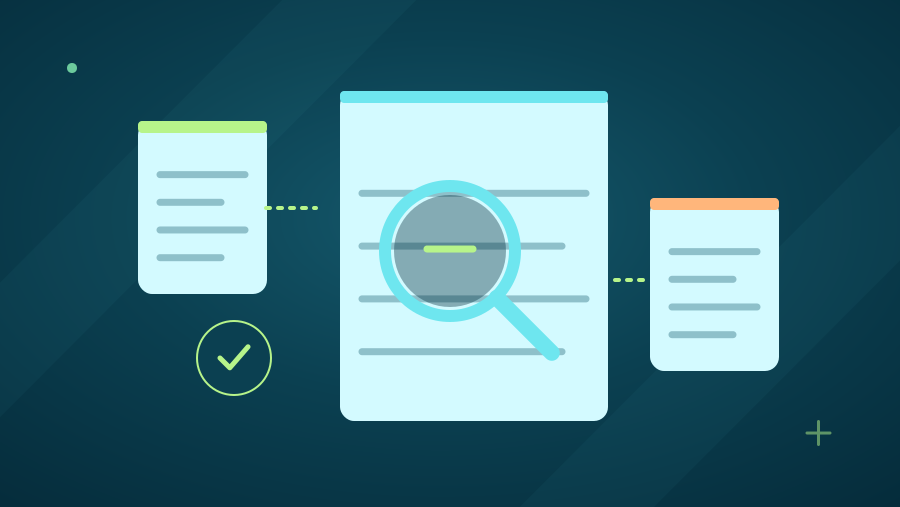
An illustrative competitor brief could assign separate research tasks for product documentation, published pricing, and corporate filings. Each worker would return source-linked observations in a shared format. A synthesising step would distinguish direct evidence from interpretation and identify contradictions. This distribution has a concrete purpose: independent evidence collection with inspectable boundaries. It does not justify giving every worker access to every institutional system.
Treat handoffs as interfaces
Specify what each agent receives and returns: task identifier, allowed sources, findings, source links, unresolved questions, and completion state. Validate that output before the next step uses it. A fluent summary is a poor handoff if it removes the qualifications another step needs. Separate a worker's suggestion from an authorised instruction to execute an action.
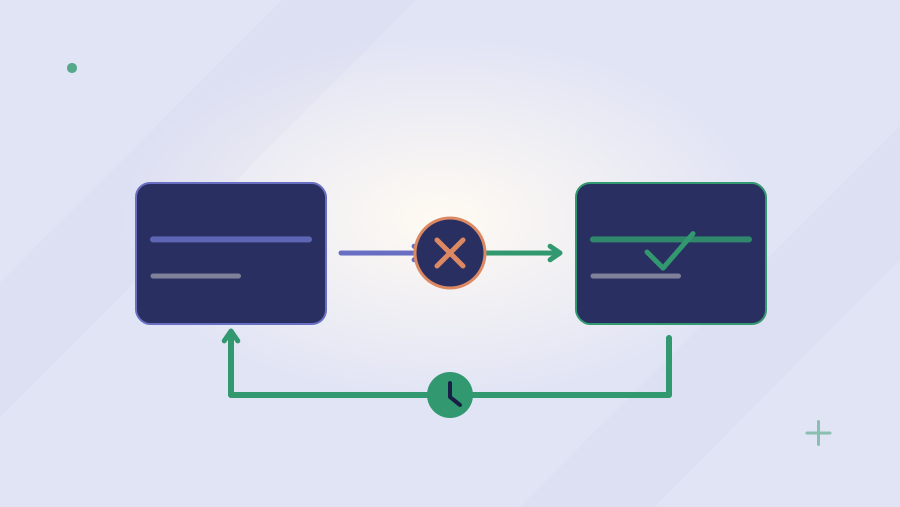
Set time, cost, and step limits for the complete run and for each worker. Define how the coordinator handles partial results, conflicting findings, and failed subtasks. Avoid endless delegation or repeated review loops with no clear stopping rule. An operator should be able to see which work completed and why the final result includes or excludes it.
Do not assume reviewers are independent
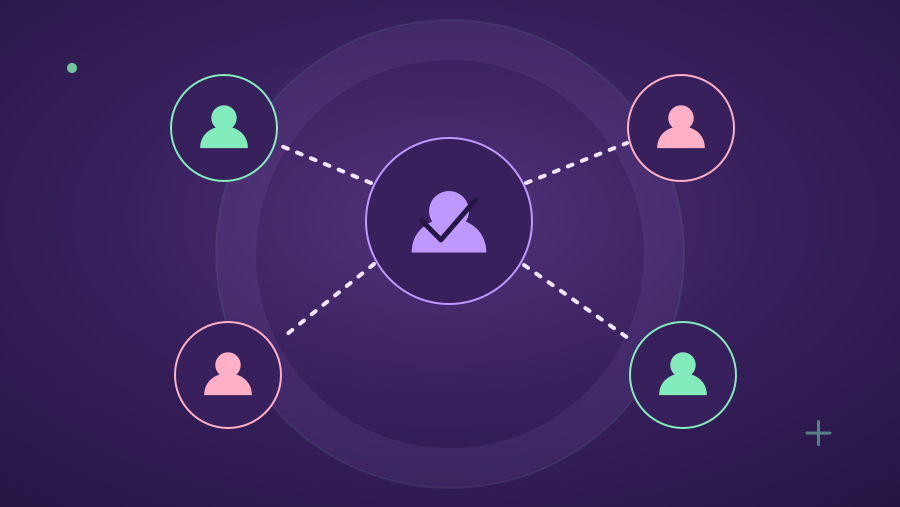
A second model or agent can provide useful review, but agreement between agents is not proof of correctness. They may share the same incomplete source, interpretation error, or missing context. Use source checks, deterministic validation, expert review, and independent test cases where the task warrants them. Evaluate the complete system rather than counting how many agents approved an answer.
OWASP's agent-security guidance identifies additional concerns around agent tools, memory, and inter-agent communication. In practice, permissions should stay attached to the executing component. A worker's message should not grant the coordinator new authority, and untrusted source text should not become a privileged instruction simply because another agent summarised it. Test those boundaries explicitly.
Compare architectures on the same work
Run realistic cases through the simplest viable design and the proposed distributed design. Compare output quality, missing evidence, failure recovery, staff correction effort, elapsed time, and operating cost. Include cases with ambiguous sources and unavailable dependencies. The relevant decision is whether added coordination produces a useful improvement for this workflow.
A custom development proposal should explain the reason for each component and what evidence would justify keeping it. If multiple agents do not improve the agreed outcome, the team can simplify the design. If they do, document their interfaces, permissions, and recovery process so the institution can maintain the system beyond the demonstration.
Sources & further reading
Primary references checked for this article. Practical examples are illustrative, not client results.
Apply this to your project.
Talk to us about a custom AI agent that connects your information and tools, respects access permissions, and asks for review when a task needs human judgment.
Explore AI Agent Development