Handle partial receipts, extra charges, and revised purchase orders through an evidence-linked accounts-payable review rather than treating extracted invoice data as payment authority.
HOW WHITE STORM WOULD APPROACH IT
A design you can explore.
Illustrative White Storm project concept with sample records; not a live product or client implementation.
Interactive design concept with sample data. This illustrates a possible project; it is not a delivered client system or an available AI product.
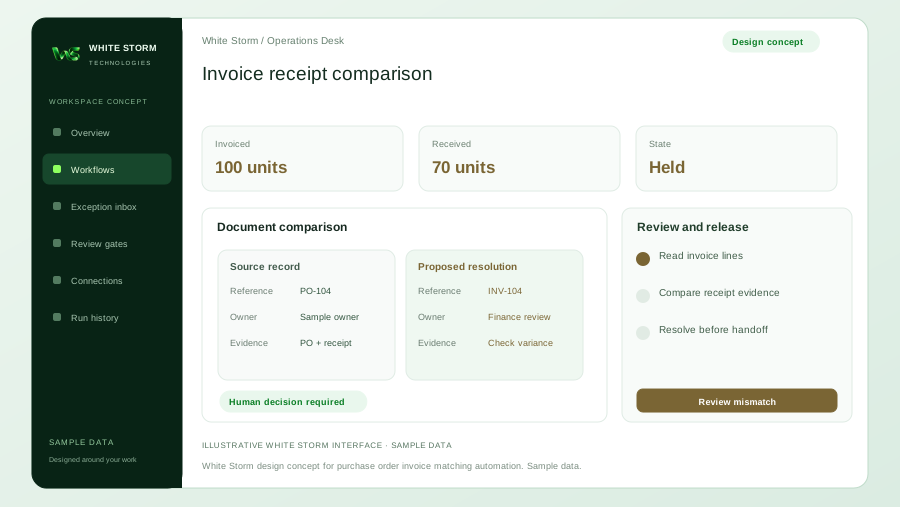
 WHITE STORMOperations Desk
Invoice receipt comparison
A supplier invoices 100 units but only 70 are recorded as received
Read invoice lines
Open order and receipts
Inputs, tool access, exception handling and acceptance criteria would be agreed with your team before implementation.
Estimate time and cost for your workflow
These editable figures are an illustrative scenario, not a White Storm quote or a forecast. Assisted work, review and expected rework are counted separately.
Enter all costs in the selected currency. Changing the label does not convert amounts.
At the illustrative defaults: 25 hours of monthly capacity, INR10,000 of capacity value after running costs, and an eight-month indicative recovery period.
Time capacity is not guaranteed cash savings. Real benefit depends on workload, quality, redeployment, integrations, licences, hosting, model use and maintenance. A negative result can favour a simpler configured solution.
Hours = monthly cases × (current − assisted − review − rework minutes) ÷ 60. Value after running costs = hours × loaded hourly cost − monthly running costs. Recovery = one-off costs ÷ positive monthly value.
Correct extraction does not establish that an invoice is ready
An invoice can be read accurately and still charge for goods that have not arrived. It may combine several orders, include freight absent from the purchase order, or refer to a unit of measure used differently in the warehouse. These are business matching problems, not merely document-reading errors. The operational goal is to present the unresolved difference to the right person with the necessary evidence. Treat the creation of an unposted draft, the approval of an expense, and the release of payment as separate authorised events.
Check the accounting platform before building a matcher
Microsoft documents invoice extraction in AI Builder and purchase-order and receipt matching in Business Central, including partial-invoice scenarios. Existing finance software may therefore cover much of the workflow. Evaluate supported functions against the actual examples before proposing a new AI application. A custom layer might address a separate warehouse system, inconsistent supplier references, or an awkward exception handoff. It should not reproduce accounting controls unnecessarily or suggest that a generic language model can establish receipt of goods from a supplier's invoice alone.
Collect purchase and receipt evidence
The client should provide sample invoices, purchase orders, receipt records, supplier identifiers, unit mappings, and the permitted tolerance policy. Include a revised order, a partial delivery, freight, credit notes, and a disputed quantity. Finance must identify which system records goods receipt and which team can resolve a discrepancy. Document whether an order can cover multiple invoices and how already invoiced quantities are represented. Avoid granting broad payment access for an extraction pilot; the initial scope can end at a reviewed draft and an assigned exception.
Follow an incomplete delivery through the proposed screen
In an illustrative example, a supplier invoices 100 units while the warehouse has recorded 70 received. The concept view would show the order, invoice, receipt quantity, and the unresolved balance. A reviewer could identify a late receipt entry or request clarification from purchasing. Freight would appear as its own line requiring the appropriate rule, rather than being forced into an item match. The system would not mark the invoice payable simply because its total agrees with the original purchase order. Posting and payment would remain with authorised finance controls.
Scope an exception assistant around established records
White Storm could connect approved finance and warehouse sources, normalise references, and present proposed matches with the original document evidence. Deterministic calculations should compare quantities, currencies, and permitted tolerances; AI could help interpret descriptions where the mapping is unclear. Maintain separate states for extracted, matched, exception, reviewed, and handed off. If a source is temporarily unavailable, identify which check could not run. A successful document extraction must not make an incomplete receipt check look complete or conceal a partially written accounting draft.
Test quantities and changes rather than easy documents
Acceptance should include multiple receipts, reversed receipts, duplicate invoices, credit notes, and a purchase order changed while review is pending. Check that a quantity already invoiced is not allocated twice. Test whether a reviewer can trace every proposed match to a source record and determine who resolved an exception. Keep material differences visible even when a reviewer accepts them under an approved policy. The operations report should distinguish unresolved matching work from technical connector failures, since those queues have different owners and recovery steps.
Configure first and retain the accounting boundary
Use supported matching and approval configuration when it covers the client's evidence and exception rules. Custom integration is appropriate only for demonstrated gaps in source access, matching presentation, or cross-team ownership. Ask the supplier to show a correctly extracted invoice that is deliberately held for a receipt mismatch. The handover should include mappings, tolerances, test cases, and operational responsibility. This article describes a possible scoped integration project, not a ready-made White Storm accounts-payable product or a promise to eliminate finance review.
Price the complete operating workflow
Time receipt investigation, purchasing clarification, and finance rework separately from extraction. Keep posting and payment controls in the approved accounting process.
Planning example only, not a quotation or forecast: assume 300 items each month, 14 minutes of current handling per item, 5 minutes of proposed human review per item, and another 18 minutes of rework for 10% of items. The difference is about 36.0 staff hours per month. At an assumed USD 40 per staff hour, that represents about USD 1440 of capacity before operating costs. These invented inputs demonstrate the calculation; measure your own volumes, handling times, exception rate, and labour cost before making a purchasing decision. Released capacity is not automatically a payroll saving.
Compare the accounting platform's existing matching configuration with any additional warehouse integration. Include extraction or model usage, finance licences, connector costs, reviewer checks, and purchasing clarification. Delivery effort should cover quantity mappings, partial receipts, credits, and a clear boundary before posting or payment. Budget maintenance when suppliers change document layouts or warehouse codes. Retain the cost of unresolved discrepancies in the operating estimate. The handover should show how to reconcile a draft with its order and receipts and identify who can accept an exception under the client's policy.
Sources & further reading
Research reviewed on 17 October 2026. Platform capabilities depend on version, plan and configuration. Primary references checked for this article. Practical examples are illustrative, not client results.
Apply this to your project.
Discuss workflows that bring purchasing, supplier, and payment records together, so finance staff can review discrepancies and approve sensitive changes before an action is taken.
Explore Business Process Automation