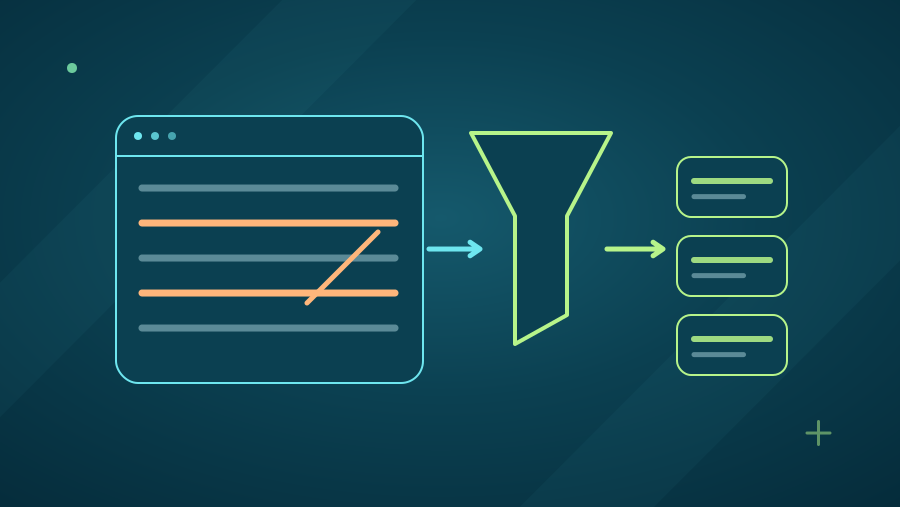
Connect each question to an improvement decision
A student feedback survey should help the institution decide what to investigate or improve. Start with a few decisions, such as changing assignment instructions, reviewing tutorial availability, or improving access to course materials. Map each proposed question to one decision and an owner. Remove questions that collect interesting information without a realistic use for the answer.
Define who can answer from experience and when the experience occurred. Students who have not used academic support cannot evaluate its usefulness. A survey about the past four teaching weeks asks something different from a survey about the whole programme. State the reference period in the question or shared instructions and use routing where appropriate.
Ask about one concrete experience at a time
Pew Research Center's questionnaire guidance recommends clear, specific wording and questions that address one concept. Apply that principle to institutional language. An illustrative question asking whether teaching and assessment were helpful combines two experiences. Separate it into an item about teaching explanations and another about assessment instructions, with response options suited to each.
Replace broad judgements with observable experiences when that helps the decision. Instead of asking whether communication was excellent, ask how easy it was to find the deadline for the most recent assignment. Avoid assuming that students received a message or attended a session. Establish the relevant experience before asking them to rate it.
Remove wording that points towards an answer
A question such as how much students valued the new support service implies that it was valuable. An illustrative alternative asks how useful the service was, offering a balanced range from not useful to very useful and a separate option for people who did not use it. Keep promotional descriptions out of the question text.
Avoid questions that suggest the institution expects praise or attach an answer to a student's effort or character. Explain the purpose of the study and describe confidentiality accurately. If responses can be connected to student records, do not promise anonymity. A clear account of how feedback will be used helps students understand the request without pushing them towards a favourable rating.
Design answer options that preserve meaning
Choose response options that match the question. Frequency, ease, usefulness, and agreement are different measures. Keep ordered scales in a logical order and use the same direction consistently where possible. Pew also highlights the importance of response categories that cover reasonable answers without overlapping. Distinguish a neutral judgement from not applicable, do not know, and prefer not to answer.
For an illustrative attendance question, categories such as zero sessions, one session, two sessions, and three or more sessions give clear boundaries. Categories such as one to three and three to five overlap. For multiple-response items, explain that students may select more than one answer and plan how the dashboard will describe the resulting percentages.
Test comprehension, routing, and local meaning
Ask a small, varied group of intended respondents to explain what they think each question means and how they selected their answer. Test on the devices students actually use. Check required fields, screen-reader labels, routing, progress messages, and the submitted data. A technically functioning form can still collect answers to a question students interpret differently.
For institutions serving India, the US, and the UK, review terms such as course, module, college, and tutorial in context. Pew's translation guidance treats cross-national comparability as a planned process. Use capable language reviewers and test translated versions with intended respondents. Preserve the version history so a wording change is visible when comparing future survey waves.
Plan review and analysis before launch
Prepare the analysis plan while editing the questionnaire. Define denominators, intended subgroup comparisons, small-group reporting rules, and how open comments will be handled. AAPOR recommends pretesting and attention to questionnaire design as part of sound survey practice. Freeze an approved version for launch and document any emergency change made during collection, including which respondents received it.
AI can suggest alternative wording and flag assumptions, but educators and researchers need to approve meaning, local context, and respondent treatment. White Storm Technologies can create a custom survey design and analysis workflow with a question-to-decision map, tested form, codebook, and reporting plan. That gives the institution a coherent route from a student answer to a practical improvement.
Sources & further reading
Primary references checked for this article. Practical examples are illustrative, not client results.
Apply this to your project.
Discuss a survey designed around your research question and intended respondents, with clear questions, tested routing, and researcher review before data collection.
Explore AI Survey Design