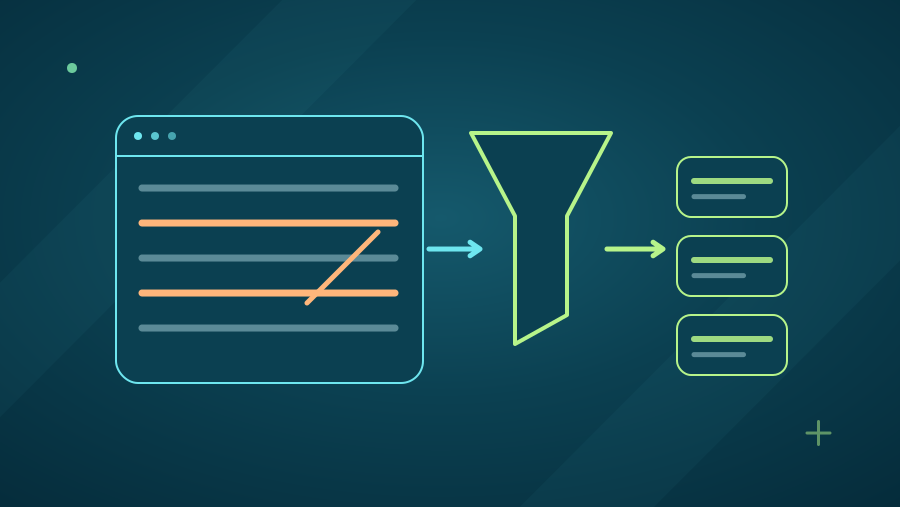
Preserve the raw export and define the analysis population
Survey cleaning should create a dependable analysis copy while preserving the original evidence. Save the raw export with its questionnaire version, collection dates, export settings, and field definitions. Restrict access as appropriate and work from a copy. Give every response a stable identifier that remains available through cleaning, coding, and reporting, without exposing direct identifiers in general analysis outputs.
Define inclusion rules before inspecting headline results. Specify eligibility, valid submission status, treatment of partial responses, and the relevant collection window. For an illustrative course survey, a student who withdrew before the reference period may be outside the target group rather than dissatisfied. Record that distinction so population decisions are not confused with judgements about answer quality.
- Archive the source export and questionnaire version.
- Confirm eligibility and submission rules.
- Validate fields, labels, and duplicate handling.
- Distinguish missing values and routing statuses.
- Review range, logic, and quality flags.
- Document transformations and exclusion decisions.
- Reconcile reporting bases before release.
Check structure, labels, and duplicate submissions
Confirm that each expected question has the right field, response labels, and data type. Inspect whether multiple-response answers arrive as separate columns or combined text. Verify date parsing and time zones, especially when collecting across India, the US, and the UK. Keep original category codes available when creating readable labels, and check that code-to-label mappings are complete.
Investigate duplicate identifiers and repeated submissions with the platform's documented behaviour in mind. An export may contain a revised response or a resumed session. Use an agreed rule, such as retaining the latest valid submission when revisions are explicitly allowed. Similar comments or a shared network address alone are insufficient reasons to assume two students are the same person.
Separate missing answers from meaningful zeroes
Distinguish not asked because of routing, shown but unanswered, not applicable, do not know, and declined. A blank cell may have any of those meanings depending on the questionnaire and export. Do not convert all blanks to zero or a neutral rating. Preserve a missingness code where the distinction affects the denominator or interpretation.
In an illustrative support survey, students who did not use tutorials should remain outside the usefulness-rating base when routing was designed that way. Check missingness by question and intended reporting group. AAPOR's work on online sample quality includes missing data among the issues that affect data quality; an overall completion count cannot explain where answers are absent.
Validate ranges and routing against the questionnaire
Create checks for allowed categories, plausible numeric ranges, and relationships between answers. Verify that a respondent who selected no use of a service was routed appropriately. Investigate impossible combinations against the original form logic. Correct a documented transformation error, but do not invent what a respondent intended when the source data is ambiguous.
Keep flags separate from final exclusions. A brief completion time, repeated scale selections, or an unusual answer can be a reason for review without proving invalidity. Use several contextual checks and an agreed decision process. Examine whether quality rules disproportionately remove respondents using assistive technology, translated questionnaires, or other legitimate routes through the survey.
Document transformations and test their consequences
Create derived fields through repeatable rules rather than ad hoc spreadsheet edits. Record recoding, scale direction, combined categories, open-comment coding, and any imputation. If a composite measure is used, document its intended meaning and handling of missing components. Verify the calculations with a few hand-worked records and compare summary counts before and after each major transformation.
Assess how exclusions affect key results and subgroup coverage. If a reasonable alternative rule changes the conclusion, disclose that sensitivity. AAPOR's disclosure guidance calls for describing quality checks, exclusions, imputation, and automated coding. Keep an exclusion log with identifiers, reasons, rule version, and reviewer, so the cleaning process can be explained and reproduced.
Release a dataset with an audit trail
Before reporting, reconcile the number of collected, eligible, excluded, partial, and analysed records. Check every chart denominator against the intended question base. Review small groups and free text for disclosure risks. Package the analysis dataset with a codebook, cleaning log, version details, and known limitations. Cleaning improves the handling of collected responses; it cannot repair an unsuitable recruitment design.
AI can suggest validation rules, identify suspicious patterns, and help document exceptions. Keep consequential cleaning decisions reviewable and perform arithmetic with dependable analysis tools. White Storm Technologies can implement a custom cleaning workflow around an institution's survey exports, questionnaire logic, and reporting needs, with repeatable checks and handover documentation that support future survey waves.
Sources & further reading
Primary references checked for this article. Practical examples are illustrative, not client results.
Apply this to your project.
Talk to us about turning your survey or business data into useful findings, with data-quality checks, clear explanations, and human review of the conclusions.
Explore AI Data Analysis