Define support in each language
A multilingual assistant needs a clear service promise for each language. Does it support only navigation, general institutional questions, authenticated services, or every part of the conversation? Which content has an approved translation? Which staff team receives a handoff? These decisions matter more than the number of languages listed in a demonstration.
Start with institution-provided evidence about the people and workflows needing support. Do not infer language requirements from a country label alone. A college in India, a university in the US, and a training provider in the UK may each serve multilingual users with different needs. Define the first release using actual questions and available review capacity, then expand when the institution can maintain the added content and service routes.
Separate source language from answer language
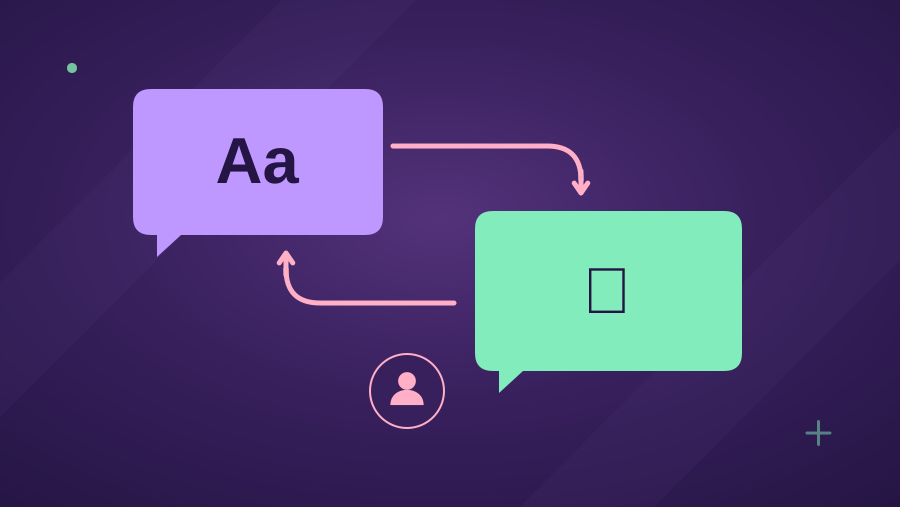
Record the authoritative source for each topic and whether an approved translation exists. Decide how the assistant should behave when a question arrives in a language without an approved source. Options include providing a clearly identified translation of an approved answer, showing the original source alongside it, or handing the question to a suitable team. Choose the approach by topic and consequence.
An illustrative admissions workflow might permit translated navigation instructions while requiring applicants to consult the official wording for a qualification requirement. The assistant should explain that distinction clearly. A fluent translation can still change a condition or omit an exception. The content owner must decide what can be translated automatically and what needs a reviewed version before publication.
Create a shared terminology record
Institutional terms rarely map perfectly across languages. Build a reviewed glossary for programme names, award levels, application stages, office titles, fees, and document types. Preserve official names where translating them would make the correct form harder to find. Include approved abbreviations and the variants users actually type.
An illustrative Hindi-English test set could include mixed-language questions, English course names inside Hindi sentences, and locally familiar spellings. A separate English-language test might distinguish admission, enrolment, and registration within the institution's own process. These examples are design possibilities, not measured language preferences. Bilingual reviewers should judge whether the response preserves meaning and directs the user to the correct institutional step.
Test meaning and usability together
Review factual correctness, completeness, tone, terminology, and the clarity of the next action in each supported language. Use equivalent scenarios rather than translating a single easy English question repeatedly. Include dates, amounts, eligibility conditions, negation, missing details, and requests for exceptions. A response should not become more permissive simply because the question uses another language.
Inspect the interface as well as the generated text. Check language identification, keyboard input, text expansion, line wrapping, screen-reader behaviour, and any right-to-left layout required by the selected languages. W3C documents language-related accessibility requirements within WCAG. The project should specify what it will test and preserve an accessible human contact route when the chatbot cannot handle the user's language.
Design a workable multilingual handoff
Tell users which languages staff can support and through which channels. If an AI-generated translation accompanies a handoff, identify it as such and preserve the original message where the approved data-handling process permits. Staff should know what the student actually wrote and which part the system inferred or translated. Let users correct the summary before submission.
Test what happens when no matching language queue is available. The assistant should explain the real alternative rather than promise language support the institution does not provide. Monitor unresolved cases by language and task, with suitable access controls and data minimisation. Differences can reveal missing content, confusing terminology, or an unsupported service route; they should not automatically be interpreted as a model-quality problem.
Budget for language ownership
Every approved source update may require glossary and translation review. Name an owner for each supported content set and define the publication sequence when one version changes before another. A limited service that accurately describes its language boundary can be more maintainable than an extensive list with no review process.
For a custom implementation, provide representative questions, approved terminology, proposed language scope, and available bilingual reviewers. Acceptance should cover complete service journeys in each supported language. The result is an institution-specific support workflow with explicit quality evidence, rather than a claim that multilingual fluency alone establishes reliable student support.
Sources & further reading
Primary references checked for this article. Practical examples are illustrative, not client results.
Apply this to your project.
Discuss a student-support chatbot that uses approved institutional information and connects unresolved questions to staff, with clear confirmation when a support request is created.
Explore Education Chatbot Development